Choosing residential fencing for a Fayetteville backyard starts with understanding what the fence needs to accomplish. Privacy, pet containment, pool safety, appearance, budget, and the way the yard is used can all point toward a different solution.
The property itself also influences the decision. Yard size, slopes, drainage, gate locations, utilities, HOA requirements, and local zoning considerations can affect which fence design works best before material selection even begins.
A fence that works well for one Fayetteville home may be a poor fit for another. The best choice should balance function, appearance, site conditions, and long-term expectations rather than rely on one material being universally better.
This guide compares the main residential fencing options available for Fayetteville backyards and explains how homeowners can choose based on privacy, durability, cost, pets, pools, appearance, and property conditions.
What Should You Consider Before Comparing Fence Materials?
Start with the primary job the fence needs to perform. Privacy, containment, visibility, appearance, and budget should guide the material comparison rather than the other way around.
Before comparing specific fence options, homeowners should consider:
- How much privacy the yard needs
- Whether pets or children will use the enclosed area
- Whether a pool barrier is involved
- How visible the fence will be from the street
- How much ongoing upkeep is acceptable
- Where gates need to go
- Whether the yard slopes or drains unevenly
- Whether HOA or local rules affect the design
For example, a homeowner who mainly wants backyard privacy will evaluate fencing differently from someone whose priority is keeping a dog contained while preserving open sightlines.
Once those priorities are clear, the material comparison becomes much more useful.
How Do Wood, Vinyl, Aluminum, and Chain Link Compare?
Each material fits a different set of priorities. Wood and vinyl are common privacy choices, aluminum works well where open views and appearance matter, and chain link is often practical for functional containment.
Fence Material Comparison
| Consideration | Wood | Vinyl | Aluminum | Chain Link |
| Privacy | Excellent with solid styles | Excellent with privacy panels | Limited | Limited unless screening is added |
| Appearance | Natural and traditional | Clean and uniform | Ornamental and open | Functional and simple |
| Upfront cost level | Varies by style and lumber | Often higher than basic wood or chain link | Often higher than basic chain link | Commonly one of the more economical options |
| Ongoing upkeep | Typically more | Typically lower | Typically lower | Typically lower |
| Visibility | Low with privacy styles | Low with privacy styles | High | High |
| Pet containment | Good with proper height and layout | Good with proper height and layout | Good when spacing fits the pet | Good with suitable mesh and bottom clearance |
| Pool applications | Depends on design and compliance | Possible with compliant designs | Common open-style option | Possible with compliant designs |
| Best fit | Privacy and natural appearance | Privacy with less routine upkeep | Decorative boundaries, pools, open views | Functional boundaries and larger areas |
The table is only a starting point. Fence height, style, gates, grade changes, and the specific product being installed can change how well any material fits a property.
Is a Wood Fence a Good Choice for Fayetteville Homes?
Yes. Wood is a strong option for homeowners who want privacy, a traditional appearance, and flexibility in fence style.
Solid wood styles can create substantial backyard screening, while spaced-picket or decorative designs can provide more openness. Wood also works well when homeowners want the fence to visually blend with landscaping or a more traditional home.
Choose wood if:
- Backyard privacy is a major priority
- You prefer a natural appearance
- You want several style and height options
- You need flexibility around gates or property layout
- You are comfortable with a material that generally requires more long-term care than vinyl or aluminum
The main trade-off is that wood changes as it ages and is more exposed to moisture and weather than manufactured fence materials.
In Fayetteville’s humid climate, wood upkeep, drainage around posts, mildew, soil moisture, and corrosion-resistant hardware should be part of the material decision.
For that reason, wood should not automatically be chosen simply because privacy is important. Homeowners should also compare how much long-term upkeep they are willing to accept.
When Is Vinyl Fencing the Better Option?
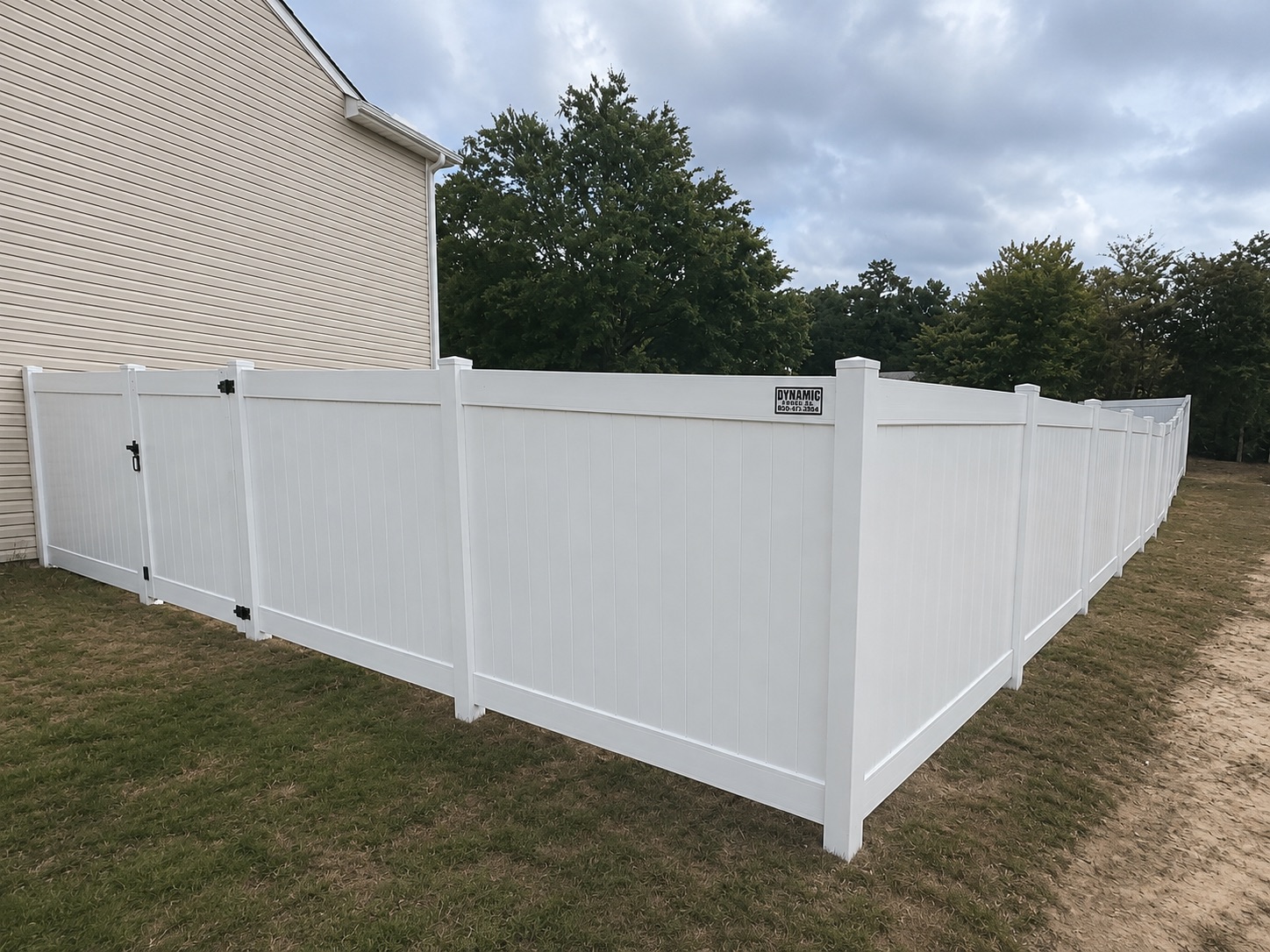
Vinyl may be the better choice when homeowners want strong privacy and a consistent appearance without choosing a wood fence.
Solid vinyl panels can create a substantial visual barrier around backyards, patios, pools, and outdoor living areas. Because the material does not rely on wood boards, homeowners also avoid some of the natural variation associated with lumber.
Choose vinyl if:
- Privacy is important
- You prefer a clean, uniform appearance
- Lower routine upkeep is a priority
- You want a fence that does not visually change like natural wood
- Your property layout works well with the available panel styles
However, vinyl is not automatically the best privacy fence for every yard. Panel design, slope, gate placement, wind exposure, and site conditions still affect the finished installation.
Solid vinyl privacy panels can catch more wind than open fence styles, so post setting, panel design, and site exposure should be reviewed.
A property with significant grade changes may also require more planning because rigid privacy panels do not always follow terrain the same way as other fence systems.
Is Aluminum Fencing Worth Considering for Your Backyard?
Yes. Aluminum makes sense when homeowners want an open, decorative fence that defines the property without blocking views.
Ornamental aluminum works especially well around landscaped yards, visible front or side areas, and properties where the fence should complement the home rather than create a solid wall.
Choose aluminum if:
- You want an open view through the fence
- Appearance and curb appeal matter
- You do not need full backyard privacy
- The fence may surround a pool
- You prefer an ornamental look
- Your yard needs a material that can work with certain grade changes
Aluminum can also be useful when homeowners want to separate spaces without making the backyard feel enclosed.
However, picket spacing and bottom clearance deserve attention when pets are involved. A fence that works well for a larger dog may not contain a much smaller animal.
When Does Chain Link Fencing Make the Most Sense?
Chain link often makes the most sense when the primary goal is practical containment, an open boundary, or enclosing a larger area without emphasizing privacy.
It can work well for pets, side yards, larger residential properties, utility areas, and locations where visibility through the fence is useful.
Choose chain link if:
- Function is more important than a decorative appearance
- You need to enclose a larger area
- Visibility through the fence is useful
- Pet containment is a major goal
- Budget is an important part of the decision
Chain link does not provide the same visual screening as a solid wood or vinyl fence. Therefore, homeowners who want a secluded backyard should generally compare privacy materials before choosing it.
The fence height, mesh, gates, and bottom clearance should also match the purpose of the enclosure.
Which Fence Material Provides the Most Backyard Privacy?
Wood and vinyl are usually the strongest choices when full backyard privacy is the primary goal.
Solid wood privacy fences use closely spaced or overlapping boards to block direct views. Vinyl privacy fences use solid or nearly solid panel systems to create a similar visual barrier with a different appearance and material profile.
Choose wood if you prefer a natural look and greater style flexibility. Vinyl may be better if you want a more uniform appearance and less routine upkeep.
Aluminum and chain link are generally open fence systems. They can define the property and support containment, but they should not be selected when the homeowner expects the fence itself to provide the same level of screening as a solid privacy panel.
Which Fence Is Best for Dogs, Children, or a Backyard Pool?
The best fence for pets, children, or a pool depends on more than material. Height, openings, bottom clearance, gates, latches, and the complete enclosure layout can matter just as much.
For pets, homeowners should consider the animal’s size, jumping ability, digging behavior, and whether it can fit between pickets or beneath the fence.
For children, the layout should account for gates, access points, and areas where changes in grade may create larger openings.
For pool areas, gate swing, self-closing hardware, self-latching hardware, latch placement, fence height, and openings should be reviewed as part of the complete barrier.
Homeowners should not assume that choosing aluminum, vinyl, wood, or chain link automatically makes the installation compliant. The material should follow the containment or barrier requirement rather than the other way around.
How Do Fence Materials Compare in Cost and Long-Term Value?
Fence cost depends on the complete project, not just the material price. Fence length, height, style, gates, terrain, access, demolition, and site conditions can all affect the final estimate.
In general, homeowners should compare both the initial project scope and how the material fits their long-term expectations.
| Priority | Material Often Worth Comparing First |
| Lower-cost functional enclosure | Chain link |
| Privacy with natural appearance | Wood |
| Privacy with lower routine upkeep | Vinyl |
| Open ornamental appearance | Aluminum |
| Large pet enclosure | Chain link or suitable privacy fencing |
| Pool or decorative boundary | Aluminum or another compliant system |
A lower initial price does not automatically make a material the better value. Likewise, a higher-cost fence is not automatically a better investment if it does not solve the homeowner’s actual problem.
The most useful quote compares complete fence designs with similar heights, gate requirements, and site conditions.
How Should Fayetteville’s Property Conditions Influence Your Fence Choice?
Fayetteville homeowners should consider zoning, setbacks, utilities, drainage, slopes, and property boundaries before finalizing the material and layout.
The City of Fayetteville’s Planning & Zoning staff review fence permits, setbacks, and other site-related standards. Homeowners should confirm current requirements for their specific property rather than assume every residential fence follows the same rules.
Property conditions can also change the material decision. For example, a rigid privacy panel may require different planning on a sharply sloped yard than an open fence system, while drainage areas may affect post placement and bottom clearance.
Before post holes are dug, homeowners should contact NC 811 so participating underground utilities can be located and marked. Private lines, irrigation, landscape lighting, or homeowner-installed utilities may require separate locating because they may not be marked through NC 811.
HOA restrictions, easements, surveys, and property-line information may also affect fence height, style, location, and whether a preferred material works with the approved design.
Does the Best Fence Material Change if Your Yard Slopes?
Yes. A sloped yard can make some fence systems easier to adapt than others, depending on the grade and panel construction.
Wood fences can often accommodate grade changes through layout adjustments, while some aluminum systems can rack to follow a slope. Vinyl and other rigid panel systems may require stepping or other transitions depending on the product and terrain.
The severity of the slope matters more than the fact that the yard is simply uneven.
Homeowners should also consider bottom gaps. A fence that looks good from the house may still leave unwanted openings for pets or create inconsistent clearance where the terrain rises and falls.
For that reason, installers should evaluate the grade before the homeowner commits to a specific panel style.
Which Fence Material Looks Best With Different Types of Homes?
The best-looking fence usually complements the home’s architecture and landscaping rather than competing with it.
Wood often works well with traditional, craftsman, rustic, or heavily landscaped properties. Vinyl provides a cleaner and more uniform appearance, while ornamental aluminum can complement homes where open sightlines and architectural details matter.
Chain link has a more functional appearance and may fit best where the fence is less visually prominent or where enclosure performance matters more than decoration.
However, appearance should not override function. A fence that looks appropriate from the street still needs to provide the privacy, containment, access, and durability the household expects.
Should You Choose the Same Fence Material Around the Entire Property?
Not always. Some properties benefit from using different fence materials or styles for different parts of the yard.
For example, a homeowner might want stronger privacy along a neighboring property line but more openness around a landscaped section or pool area.
The decision should still feel coordinated. Fence heights, gate locations, transitions, colors, and the relationship between materials should be planned as one property rather than as separate installations.
Using more than one material only makes sense when each section solves a different problem.
How Do You Choose the Right Fence Material for Your Backyard and Budget?
Start by identifying the one or two priorities the fence absolutely needs to satisfy. Then compare materials based on those requirements instead of choosing from appearance or price alone.
Choose wood if privacy and a natural appearance are your strongest priorities.
Choose vinyl if you want privacy with a clean, uniform appearance and less routine upkeep.
Choose aluminum if you want an open ornamental fence, visibility, or a design that complements landscaping and certain pool areas.
Choose chain link if practical containment, visibility, and enclosing a larger area are more important than full privacy.
Finally, compare the material against the actual Fayetteville property. Grade, gates, drainage, utilities, setbacks, HOA restrictions, pool requirements, and the way the backyard will be used can change which option provides the best fit.
Request a Residential Fence Estimate in Fayetteville
If you are comparing fence materials for a Fayetteville backyard, contact Dynamic Fence Co to review your privacy needs, pets, property layout, gates, grade, budget, and preferred appearance before choosing between wood, vinyl, aluminum, and chain link fencing.